Components
Ten components and three helpers live in frontend/src/components/, plus the icon set in src/icons.tsx. Each reads the store with narrow selectors, sends commands through send(), and keeps local state only for things the server does not own. Shared formatters and the decision palette come from format.ts: DECISION_LABEL (allowed, fallback, escalated, all blocked), DECISION_CLASS (Tailwind classes on the outcome tokens for badges and cells), DECISION_COLOR (hex for the canvas and the timeline), HAZARD_COLOR and ACCENT_COLOR, isLaneNoop() (a lane change at the road edge changes nothing), violatedRules() (the ids of the rules the executed action broke by the ground-truth checkers, read from the record's checks) and uiScale() (the root font size over 16 px, so canvas text follows the density toggle).
status-strip
The header on both views, one row in every state. A three-column grid: brand, tabs and source on the left; the transport in a flexible middle cell; the density and shortcut buttons and the stats on the right.
SourceMenuis one native<select>styled as a badge. It readsliveor, amber, the replaying run; its options areliveplus every logged run fromhello.runs, newest first, shown asreplay 10-17 01:27 seed0_onbyrunLabel(). Pickinglivesendsload_live, anything elseload_replay. Before the firststateit is anofflinebadge.Transportholds reset (icon, with the seed input beside it), step, play or pause and the speed select in one bordered group, then the shield as arole="switch"button, thenStatusSlot. The seed input is local state mirrored fromsession.seedin an effect, so a reset from another browser updates it but typing does not round-trip until reset is clicked. Enabled state follows the session: step is disabled while playing, while an escalation is open and when the episode is done; play only when the episode is done; the shield in replay. Speed options are 0.5, 1, 2 and 4 steps per second, labeled2/s, sent asset_speed.StatusSlotshows exactly one badge, the most urgent state first: "waiting on operator" whilepaused_on_escalation_idis set, "inspecting N · esc follows live" while a tick is selected, "episode over" when done, otherwiseDECISION_LABELfor the latest record with→ <executed>when the executed action differs from the top candidate. The slot isflex-1withoverflow-hidden, so it absorbs slack and clips rather than wraps.- On the metrics tab the middle cell renders
ReportMetafromstore.report(generated time, seed count, thresholds, judge mode), and the source menu and live stats hide: the report is fixed, so nothing there follows the session. - The right cell has
LiveStatsand, in the corner after it, the "Aa" density toggle (aria-pressed, callssetDensity) and the keyboard button (setShortcutsOpen(true)).LiveStatsis four readouts in a box styled like the transport group, each a label over a mono value, left-aligned in cells separated by hairlines (divide-x) and given a minimum width that covers the widest usual value, so the row holds still as the numbers change. They are step (with total fromtotal_stepsin replay orconfig.durationlive), Jev source and latency, cost so far, violations so far. Jev and cost carrymax-[1440px]:hidden talk-hide, so they drop below 1440 px and at talk density; the reset label drops at talk density too.
road-view
A Canvas 2D view with its own animation loop and a DOM overlay for the HUD and the legend.
| Constant | Value | Meaning |
|---|---|---|
VIEW_M |
160 | Metres of road across the canvas, right of the gutter |
EGO_OFFSET_M |
50 | Ego sits 50 m from the gutter, so 110 m is visible ahead |
GUTTER_PX |
44 | Lane labels live here, outside the road surface; scaled by uiScale() |
HUD_PX |
40 | The band the DOM overlay occupies; the road starts below it |
MIN_LANE_H, MAX_LANE_H |
40, 120 px | Lane height clamps; lanes grow to fill the canvas |
LANE_WIDTH_M, CAR_L_M, CAR_W_M |
4, 5, 2.2 | Scale for cars |
The component keeps a Frame ref (prev, cur, t0, intervalMs) rather than redrawing on React renders. One requestAnimationFrame loop calls render() every frame; an effect replaces the frame whenever the view step, the previous step or the speed changes, with intervalMs = 1000 / speed. render() computes alpha as the elapsed fraction of the interval and linearly interpolates ego position, ego lane and every other vehicle (matched by id between prev and cur), so cars glide between steps instead of jumping. While inspecting, t0 is set to 0 so alpha is 1 and the frame is drawn at rest.
Drawing order: shoulders and surface, lane lines (the dashes are world-fixed, so lineDashOffset scrolls them with the ego's x), lane labels in the gutter, then everything on the road inside a clip rectangle so nothing bleeds into the gutter: zones, traffic, the ego, the arrows, the chip. carSize() gives a car its true length along x and caps its height at length / 1.6, so a car reads as a car rather than a tile whatever the lane height; drawCar() adds a darker cabin, headlights at the front (the right end), taillights at the rear, and for the ego a white outline and a glow in ACCENT_COLOR. Zones come from the live store normally and from the inspected record's zones while scrubbing; a closed stretch is filled with a cached hatch pattern in HAZARD_COLOR, and its label is clamped inside the visible part of the zone on a dark pill. Arrows start at the car's edge: the executed action is solid in DECISION_COLOR[cur.decision] over a dark halo; when the top candidate differs from what ran it is drawn first as a dashed ghost, rose when a rule blocked it and amber when cur.floor.removed names it. IDLE, or a lane change isLaneNoop() rejects, is a hold mark (two short bars) under the car by drawHold(), on the far side from any ghost arrow. A chip above and to the right of the ego reads FASTER ✓ or FASTER ✕ → IDLE in the outcome color, clamped inside the canvas. CRASH appears beside the ego when the record says so. The canvas is resized to devicePixelRatio on every frame and the context transform set to match, so text stays crisp on retina displays. The helpers (drawCar, carSize, drawArrow, drawHold, arrowFor, lerp) and the constants are exported for the twin strip.
The overlay is pointer-transparent. Left: the "Road view" label and, once there is a record, a HUD with step, lane, speed, the outcome badge (with · FASTER blocked or · FASTER under the floor when the top candidate did not run) and the operator's answer. Bottom right, hidden while a step is selected: the legend, with swatches for the ego and the closed lane, tiny arrow glyphs for ran, blocked and floored, and the two-bar hold mark. The section is borderless on a darker surface, the one hero panel on the page.
twin-strip
The unshielded twin under the road view, titled "Without the shield". Reads twin from the store (set by the twin message), the view step from selectViewStep, selectedStep, the session speed and seed. It renders nothing unless the twin's steps are non-empty and its seed matches the session's, and app.tsx swaps it for the inspector while a step is selected. The twin step index is the view step's step, clamped to the twin's last step, so playback and scrubbing share one clock; past the twin's end the strip holds its last frame and prints CRASHED. It keeps its own TwinFrame ref and requestAnimationFrame loop and interpolates like the road view, but draws at 65 percent alpha with grey traffic, a lighter ego, lane numbers in the gutter, scrolling dashes, no zones and a neutral arrow or hold mark, in lanes 12 to 24 px high. The title line carries the current step and, when a rule with a checker is on, the twin's violations so far in rose beside the live run's so far in green (violatedRules() summed over the records up to the view step, so scrubbing moves both), how many rules are scored, and the crash step; with no scored rule it says "no scored rules on". It reads steps and constraints from the store for that, and both subtitles' tooltip names the run, the scored rules by text and the twin's total over the whole run.
decision-strip
The timeline. Reads steps, selectedStep, config.duration, twin and the session seed, and keeps a hovered index in local state. It renders max(duration, steps.length) tick buttons so the bar is full width from step 0; ticks without a record are disabled and dim. Height encodes state (selected 100 percent, present 78, empty 28), color is DECISION_COLOR[r.decision], escalated steps are fully opaque, and a record with human gets a white dot. The hover card above the bar is summary(): step N · outcome → executed, the blocked or floored top candidate, the operator's answer, violated c1, c2 and crash; it slides to stay inside the strip near either edge. Under the ticks a thin row marks the live run's violations per step, violatedRules(r).length as rose cells, darker the more rules broke, from a useMemo over steps; under that, when the seed has a twin, a second row shows twin.steps[i].violations on the same scale, solid at crashed_at, revealed only up to the latest live step so the two timelines fill together. Under that, an axis with a label every ten steps (twenty past 120), a light caret at the latest step and a white caret at the selected one. The title holds the legend as swatches. Clicking a tick toggles selectStep; the button carries aria-label="inspect step N" and aria-pressed.
inspector-drawer
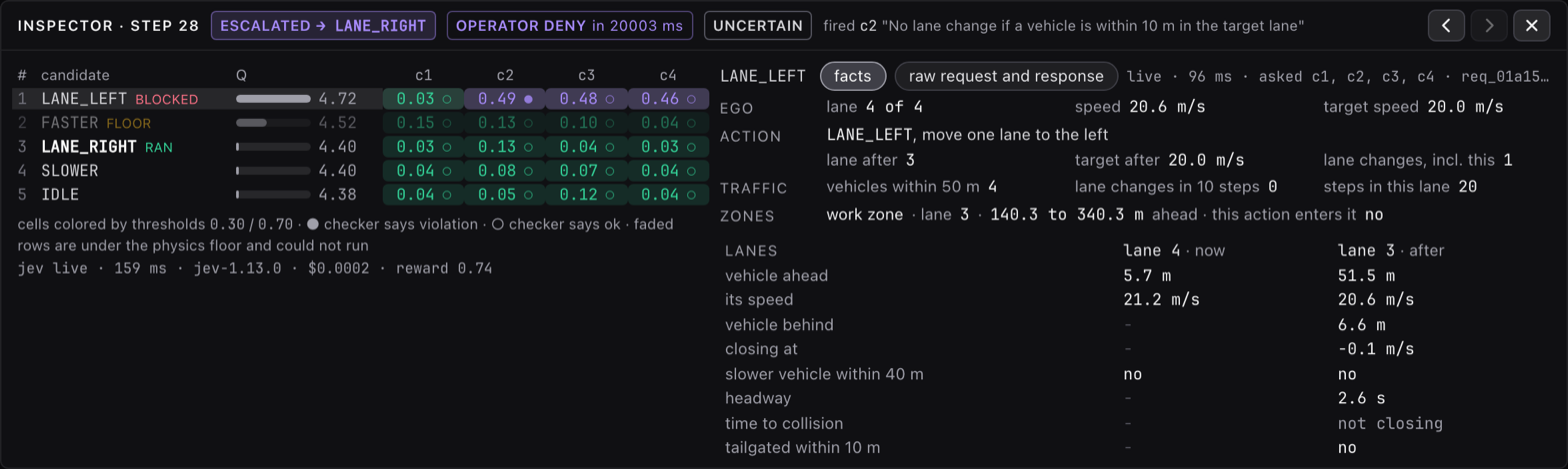
Renders only when selectInspected returns a record, in the twin's slot, capped at min(22rem, 42vh). Local state holds the chosen candidate (reset whenever the step changes) and the facts or raw tab.
- The left table lists the five candidates by rank with a grey Q bar scaled between the step's min and max Q, a
rantag on the executed action, ablockedtag on a top action that did not run, and afloortag with the row faded on a candidate the physics floor removed (record.floor.removed). One column per enabled constraint showsp_violation, coloured bypClassagainst the record's own thresholds (allow belowt_allow, blocked abovet_block, escalate between). A filled dot marks a checker label of violation, a hollow dot a label of ok, nothing when the rule has no checker. - The right side shows the chosen candidate's facts as
FactsTable(below), or the raw exchange, where the same facts appear as the request'sstate.candidateExchange()finds thejudge.exchangesentry for that action and rebuilds the request as{ model, state: candidate.facts, questions }fromjudge.questions, because the log stores the state once per candidate and the question once per constraint. A step answered entirely from the cache has no exchange, and the drawer says so. - The header carries, in priority order so the last truncates first: "Inspector · step N", the decision badge with
→ <executed>when the executed action differs from the proposal, the operator's answer and latency when there was one (an override also names the action), a badge on escalated steps withREASON_LABEL[escalation_reason]whose tooltip names thefallbackaction deny would have run and itsFALLBACK_LABEL[kind], and the fired constraint's id and text. Icon buttons move between steps and close the drawer. The judge source, latency, model, cost and reward sit under the candidates table. Action names, ids and numbers are mono; sentences are sans.
facts-table
FactsTable({ facts }) renders one candidate's facts object, the JSON Jev was sent, and computes nothing. LABEL maps known keys to short labels and UNIT gives each its unit, with a suffix rule (_mps, _m, _s) for keys neither lists, so a fact the backend adds later shows under its own name instead of vanishing; a count whose name ends in a threshold, like vehicles_within_50_m, is listed with no unit so the rule does not misread it. Four labelled groups, each a Group with a 4.5 rem title column so they line up and its Pairs in three columns (two below 1440 px): ego (lane and lane count folded into "3 of 4"), action (name and meaning on a line of their own, the rest as pairs), traffic merged with history, zones (one full-width line per zone: name, lane, extent in metres and "this action enters it", in the hazard color on yes; or "none ahead"), then one group per unknown top-level block. The lanes table follows: one column each for current_lane ("now"), lane_after_action ("after") and lane_right_of_lane_after ("to the right") when present, rows in LANE_ROWS order plus any unknown keys, while is_leftmost and is_rightmost become a "leftmost" or "rightmost" note in the column head. laneCell() reads a null gap as "none", a null that merely follows from it as a dash, and a null time to collision with a vehicle ahead as "not closing", matching the backend's prose. A label may wrap inside its cell, a value never does, and every pair and row carries its JSON key as the tooltip.
approval-queue
Reads escalation, session.shield_on, session.thresholds, constraints (for the rule text behind each candidate) and metrics.human. With nothing open it is a single title row: "empty, the shield is deciding on its own", "empty, no rules yet" or "shield off, nothing escalates", followed by the running approve, deny and override counts. With an escalation it expands in place, violet for uncertain and rose for no_compliant_action, in this order: the reason badge in the title; the proposed action and its rank; PBar, the probability as a white marker over the three bands of the current thresholds; approve and deny, with the deny button filling as remaining / timeout_s counts down and reading "auto in N s"; one line of context with what deny would execute and FALLBACK_LABEL[fallback_kind]; the "judge unavailable" badge when the backend had no answer; the fired rule's text as a quote; the first three sentences with an "all N facts" chip; and the candidates as rows with their number key, action, worst p coloured by the thresholds, the rule behind it, and proposal or no-op tags. A candidate button sends resolve with override and its action, except the proposal, which sends approve; the exported resolveWithRank() does the same for the digit keys in app.tsx. When expires_at is set, a 250 ms interval updates a local clock; with a timeout of 0 the server sends expires_at: null and no clock runs. The facts toggle resets when the escalation id changes.
constraint-panel
Reads constraints, zones, zoneNote, hello.presets, session, steps and the open escalation's p. Everything is disabled in replay or before the first state, and the title says "replay, read only".
- The text box sends
add_constraintwith the trimmed text; the server infers a checker. A hint appears when the text starts with "No" and mentions a lane change (/^no\s/iand/lane change/i), offering the positive rephrase of the gap rule; the operator's own wording is always kept. - The rule list comes first. Each row has a
role="switch"button (toggle_constraint), the text, a meta line with the id in mono, ascoredtag whose tooltip names the checker (ornot scored),fired N×from auseMemooverstepscounting records whosefired_constraintis this rule,violated N×in rose from a second memo counting records whereviolatedRules()names it, and an icon button to remove it (remove_constraint). - Presets follow under a collapsible heading that counts how many are left to add. Only presets whose text is not already in the list are shown; a chip sends
add_constraintwith the preset'schecker. The chip text truncates with the full text in its tooltip. - The zones block has the
drop_zonebutton, one hazard-coloured row per zone with its lane and absolute start and end, and the retirement note from the store. ThresholdBand(inthreshold-band.tsx) keeps a local copy of the thresholds, re-synced fromsession.thresholdsby an effect. Two range inputs overlay one track drawn as three bands (allow, escalate, block); they step by 0.05 and clamp against each other sot_allownever exceedst_block.set_thresholdsis sent on pointer up or key up, and only if a value changed, so dragging does not flood the socket. A white marker shows the open escalation's probability. The physics floor fromsession.floor_sis one line with the explanation in its tooltip; there is no control for it.
metrics-view
Fetches httpUrl("/eval/latest") once, stores the result with setReport so the status strip can show its metadata, and renders the report, an error (as a report with available: false), or the server's instruction to run the evaluation. Five tiles lead with the delta (30× fewer, -9.4% return, 40% → 0%, 16.5% of steps, $0.0005 / episode) with shield off and on under it. Four chart panels follow, each shrink-0 so a tall table never bleeds into the next panel:
| Panel | Chart | Beside it |
|---|---|---|
| Violations per seed | BarChart, two series from episodes[].violations_total |
|
| Task return per seed | BarChart, two series from episodes[].return |
|
| Choosing the thresholds | ScatterChart with a connecting line over sweep[] |
a table of pairs with escalated, violations and return, the default pair marked |
| Is p(violation) calibrated? | LineChart with a diagonal ReferenceLine: calibration.overall dashed plus one line per checker in CHECKER_COLOR |
a table with ECE, checks and label source per rule, in place of a legend |
Then the physics floor table, banded by threshold pair with the default pair and floor marked and numbers right-aligned, and, when a baseline exists, the chat-model reliability chart with a table of ECE, Brier, accuracy, median latency and cost per judge. Colors are blue for shield on, orange for off and aqua for the third checker; checkers without an entry in CHECKER_COLOR are not drawn. A footer line gives the report timestamp, p50 and p95 latency and the simulated operator's answer counts. The report shape is documented in Evaluation report.
toasts and shortcuts-overlay
Toasts renders errors fixed at the top center under the strip, with an icon button to dismiss, and clears them six seconds after the last push. ShortcutsOverlay renders a role="dialog" list of the keyboard shortcuts while shortcutsOpen is set; a click outside, its close button, Esc or ? closes it. Both use the enter animation.
icons
icons.tsx holds the eleven inline SVG icons the components use (play, pause, step, reset, close, chevrons, keyboard, arrow), 16 px stroke icons with aria-hidden, so a button's accessible name is its text or its aria-label alone.