Interlock
The policy was trained once. The rules changed live, in plain English.
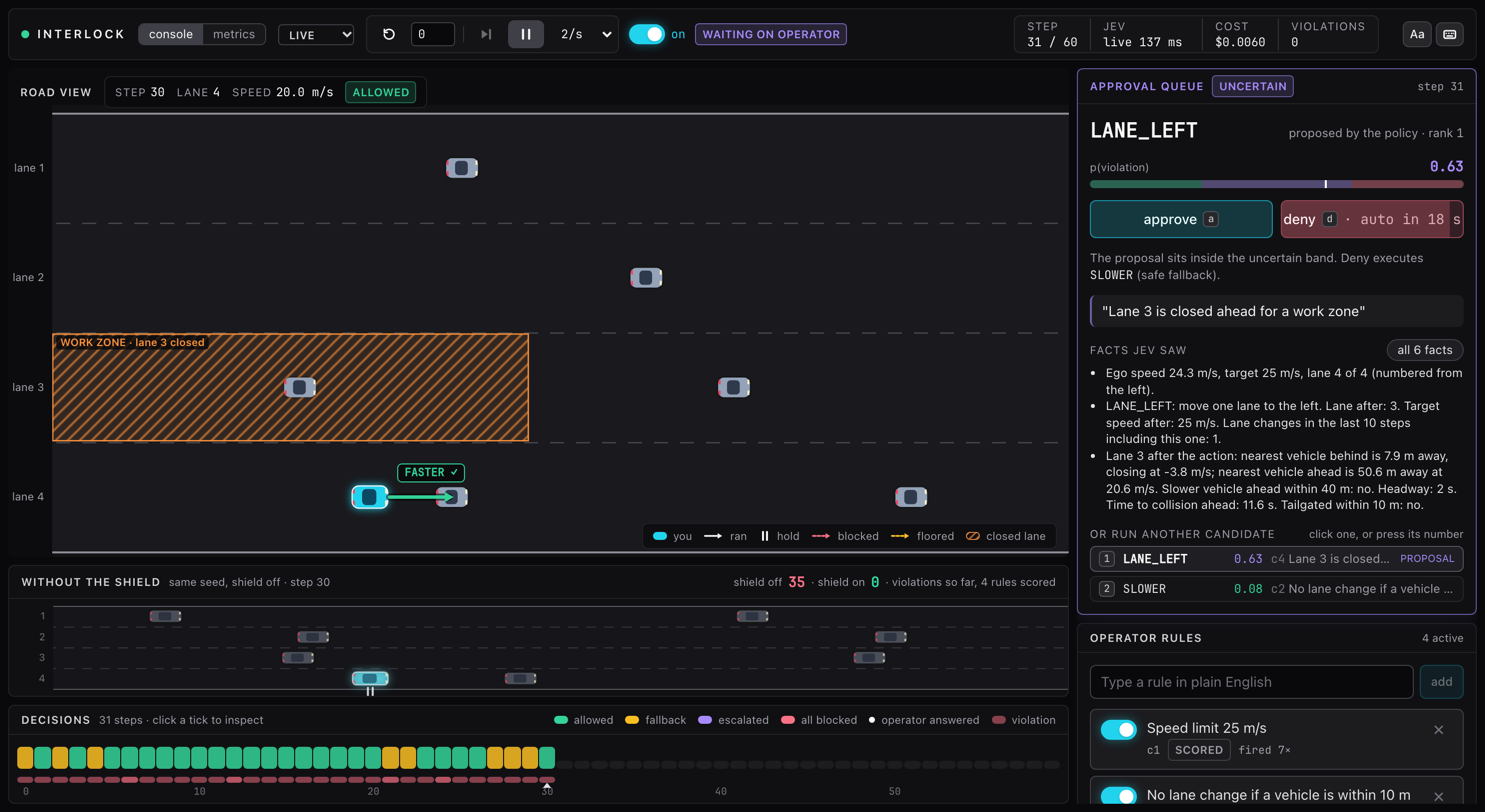
Interlock is a runtime safety shield for a reinforcement learning agent, with a human on the loop. A Stable-Baselines3 DQN drives in highway-env on task reward alone and knows nothing about rules. At every simulation step, Jev, TypeSafe's decision model, judges each of the agent's candidate actions against operator rules typed in plain English and returns a probability of violation. Code then allows the action, falls back to the agent's next-best safe action, or pauses and asks a person. An operator console shows the road, the rules, the approval queue, a decision inspector and the evaluation numbers.
Pick your track
-
User guide
For anyone who installs and runs Interlock: operating the console, adding rules, answering escalations, reading the inspector, running the command line and the evaluation, and deploying a live demo.
-
Developer guide
For anyone changing the code: the architecture, the per-step loop, the shield algorithm, facts, the Jev client, the server, the React console, the contracts between them, the tests, and how to extend each part.
-
Reference
Every environment variable, flag and constant in one place, a module by module API listing, and a glossary of the terms used across the project.
What Interlock demonstrates
- A reward-only policy made safe at runtime, with no retraining. The DQN only ever sees environment reward: speed, no collisions and a small right-lane bonus. Rules such as "Speed limit 25 m/s" or "Lane 3 is closed ahead for a work zone" are added while it drives.
- A system that knows when to ask a person. Jev's probability drives three outcomes. Confident safe runs, confident violation falls back, and the uncertain band escalates to an approval queue with the facts, the rule and the probability.
- Honest numbers. Violations, task return, crashes, escalation rate, latency, cost and calibration, measured over seeded episodes with the shield off and on, plus a threshold sweep that shows the tradeoff.
How it works
flowchart LR
  ENV[highway-env<br/>highway-fast-v0] --> POL[DQN policy<br/>5 actions ranked by Q]
  ENV --> FACTS[Fact extractor<br/>geometry in code]
  RULES[Operator rules<br/>plain English + zones] --> FACTS
  FACTS --> JEV[Jev<br/>one yes/no question<br/>per action and rule]
  POL --> SHIELD[Shield<br/>allow / fallback / escalate]
  JEV --> SHIELD
  SHIELD --> ENV
  SHIELD --> QUEUE[Approval queue<br/>human approve / deny / override]
  QUEUE --> SHIELD
  SHIELD --> LOG[(JSONL decision log)]
  LOG --> UI[Operator console]
  LOG --> EVAL[Evaluation<br/>before/after, sweep, calibration]
Each step, the policy ranks its five actions, code turns the simulator state into structured facts per candidate and drops any candidate under the time-to-collision floor, Jev answers one question per (action, rule) pair, and two thresholds split the result into allow, fallback or escalate. One JSONL record per step holds everything that happened, and the console, the replay and the evaluation all read that one record format. The architecture page walks through it in detail.
Results at a glance
Twenty seeded episodes of 60 steps with seven standing rules, live Jev, and a simulated operator that answers from the ground-truth checkers, measured on Oct 17.
| Configuration | Violations per episode | Task return | Crash rate | Steps escalated |
|---|---|---|---|---|
| Shield off | 105.45 | 50.7 | 40% | 0% |
| Shield on, thresholds 0.2 / 0.8 | 3.45 | 45.7 | 0% | 48.2% |
| Shield on, thresholds 0.3 / 0.7 (default) | 3.55 | 46.0 | 0% | 16.5% |
Put the same questions to chat models and Claude Sonnet 5.5 is better calibrated than Jev on a balanced sample, yet at the default band it would have allowed 3 violations and blocked 5 compliant actions where Jev allowed and blocked none, at about a second per check against 158 ms per step.
The evaluation page has the full sweep, the per-rule breakdown, the calibration numbers, the chat-model baseline and the reading of them.
Where things live
| What | Where |
|---|---|
| Source | github.com/sequenzia/interlock |
| Live console | interlock-demo.vercel.app |
| Live backend | interlock-backend.fly.dev |
| Backend | backend/, Python 3.12 via uv |
| Console | frontend/, Vite, React, TypeScript |
| Tests | tests/, pytest, plus a Playwright smoke test in frontend/e2e/ |
| Planning history and the evaluation report | internal/ |
Naming
Interlock is an independent personal project and is not affiliated with any company. The name is the safety-engineering term for a mechanism that permits an action only when a condition holds, with a supervised override. In these pages, "the shield" is the lowercase technical term for the mechanism that allows, falls back or escalates.